Telemetry Insights
InsightsWhy Foundation Watering Systems Fail (And What AI-Driven Monitoring Does Instead)

Why Foundation Watering Systems Fail (And What AI-Driven Monitoring Does Instead)

Stephen Harris · Founder & CEO, Telemetry InsightsOctober 2025
foundation protectionsoil moistureDrip DefenderIoTclay soil
Why Foundation Watering Systems Fail (And What AI-Driven Monitoring Does Instead)

Published by Telemetry Insights | October 2025


Walk into any big-box home improvement store in Texas, Arizona, or Georgia and you'll find soaker hoses, basic drip kits, and timer-based irrigation controllers marketed as foundation protection solutions. The category is real. The problem they're solving is real. The execution is fundamentally broken, and the gap between what these systems promise and what the soil actually needs is where most foundation damage begins.

This isn't a knock on drip irrigation hardware. It's a systems problem. A soaker hose connected to a 7-day timer has no idea what the soil is doing. It runs on a schedule. The soil operates on physics.


What a Traditional Foundation Watering System Actually Does

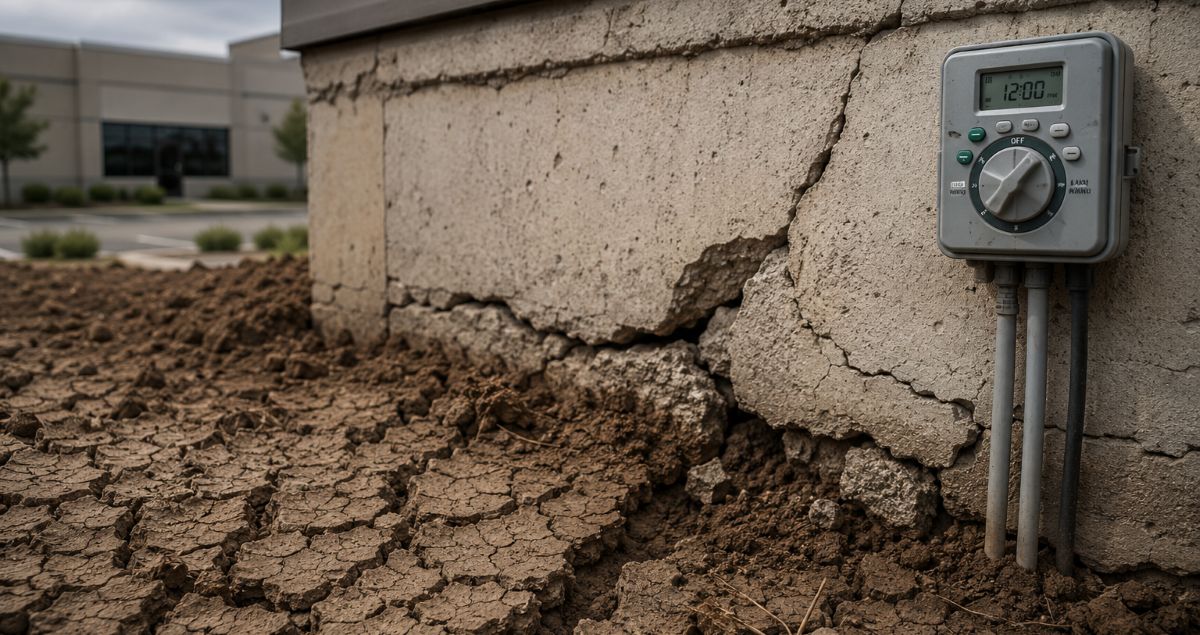
The standard foundation watering system is mechanically simple: a perimeter drip line or soaker hose installed 12-18 inches from the foundation wall, connected to a timer-controlled valve. The timer fires on a fixed schedule, say, three times a week for 20 minutes, and the line delivers water to the soil around the perimeter.

In ideal conditions, this maintains some baseline moisture. In real conditions, it fails in three distinct ways.

It runs the same schedule regardless of what the soil actually needs. After a week of heavy rain, the timer still fires. After a 10-day drought following a heat wave, the exact scenario that drives the most dangerous rapid soil shrinkage, the timer still fires on its preset schedule, almost certainly not frequently enough to compensate. The system has no feedback mechanism. It cannot sense, learn, or adapt.

It delivers water at the surface, not where the structural stress is occurring. The soil movement that damages foundations happens at depth, 3 to 6 feet below grade on typical residential and commercial properties. Surface drip irrigation moistens the top few inches. The deep clay layers where expansion and contraction forces actually develop against the foundation may be receiving almost none of that water, depending on surface runoff, evaporation rate, and soil composition.

It provides no visibility. The homeowner or property manager has no data on what the soil is actually doing. No moisture readings. No trend history. No alerts. No way to know whether the system is working until a crack appears, at which point it demonstrably wasn't.


The Failure Mode That Costs the Most

The most expensive failure scenario for foundation watering systems isn't chronic under-watering. It's the moisture swing.

Expansive clay soil, the dominant foundation substrate across the American South and Southwest, is most dangerous when it cycles rapidly between wet and dry. A foundation that has been sitting on consistently dry soil has adapted, in a rough sense, to that baseline. What destroys foundations is the rapid transition: soil that goes from saturated to severely dry over a few weeks, or from severely dry to saturated after a drought-breaking rain.

A timer-based system is structurally incapable of preventing this. It cannot detect that a heat event is driving accelerated moisture loss. It cannot detect that soil is approaching the shrinkage threshold at which clay begins to pull away from the foundation, creating the voids that lead to settlement and cracking.

By the time the damage is visible, the moisture event that caused it is weeks in the past.


What Continuous AI Monitoring Does Differently

The architecture that actually solves this problem is not a better timer. It's a sensor network connected to a cloud AI platform that understands what the soil is doing in real time and responds to trajectories, not just thresholds.

Continuous measurement at depth. RS-485 Modbus soil moisture probes deployed at the foundation perimeter capture readings at the depth where structural soil stress actually occurs, not at the surface. Readings every few minutes from every zone simultaneously create a real-time picture of the full moisture envelope around the structure.

Rate-of-change detection, not just absolute thresholds. A soil moisture reading of 22% volumetric water content is not inherently dangerous. The same reading trending down at 1.5% per day during a 10-day forecast drought window is a structural risk that needs an automated irrigation response today, before the reading reaches 15% and the clay starts shrinking. Cloud AI tracking rate-of-change catches the dangerous trajectory days before the dangerous condition arrives.

Weather forecast integration. Connecting live weather forecast data to the moisture model means the platform knows what's coming before it arrives. A 7-day dry forecast following an already-dry period triggers proactive irrigation to build a moisture buffer in the soil. The system manages to the future state, not the current reading.

Automated actuation. When the AI determines irrigation is needed, it triggers the solenoid valve directly, no manual intervention, no schedule override, no human in the loop. The response happens at 2am on a Tuesday in August if that's when the soil needs it.

Full audit trail. Every moisture reading, every alert, every irrigation event is logged to the cloud with a timestamp. Property managers, insurance adjusters, and warranty administrators have a complete, verifiable moisture history for the structure.


The Drip Defender Architecture

Drip Defender is built around this exact model. RS-485 Modbus probes at depth feed continuous data to the TI cloud platform over WiFi or LoRa mesh. The cloud AI tracks moisture levels, rates of change, weather forecasts, and historical baselines for each sensor zone. When conditions indicate risk, the platform triggers automated drip irrigation response and pushes alerts to the property dashboard and mobile app.

The sensor devices are optimized for their actual job: accurate measurement, reliable transmission, and 24-hour battery backup through power outages. All intelligence lives in the cloud, where it processes the full time-series history, integrates weather data, and applies ML models that scale without embedded hardware constraints.


Frequently Asked Questions

Can't I just run my timer more frequently?

More frequent watering reduces risk somewhat but doesn't solve the core problem: the system still has no feedback on what the soil is actually doing. You can water three times a day and still have dangerously dry soil at depth if runoff, evaporation, and soil composition mean the water isn't reaching where structural stress occurs. Frequency without measurement is still guesswork.

Do I need to replace my existing drip hardware?

Not necessarily. Drip Defender works with standard 24VAC solenoid valves, the same hardware most foundation drip systems already use. The sensor network and cloud AI layer on top of existing irrigation infrastructure, replacing the timer controller with intelligent automated actuation.

How quickly does the system respond to a detected risk condition?

Alert notifications are sent immediately when the AI identifies a risk condition. Automated irrigation response triggers on the same detection cycle, typically within minutes of the sensor reading that crosses the risk threshold.

What happens during a WiFi outage?

Sensor devices include 24-hour internal battery backup and store readings locally during connectivity gaps. When connectivity restores, buffered data syncs to the cloud. For properties without reliable WiFi at sensor locations, the LoRa mesh architecture extends coverage without additional wiring.

Is this only for clay soil properties?

Clay soil properties face the highest risk from moisture fluctuation and see the most dramatic results. Sandy and loamy soils benefit less from proactive moisture management but still benefit from continuous monitoring for drainage anomalies, overwatering detection, and property documentation.


Learn more about Drip Defender → Related: How Soil Moisture Destroys Foundations | The Hidden Cost of Expansive Clay Soil


Why Foundation Watering Systems Fail (And What AI-Driven Monitoring Does Instead) | Insights | Telemetry Insights | Telemetry Insights