Published by Telemetry Insights | May 2026
Foundation damage has a reputation for being mysterious, invisible forces working unseen beneath a structure until the day a crack appears in the drywall or a door stops closing properly. That reputation is undeserved. The process by which expansive soil destroys foundations is well understood, follows a predictable sequence, and produces detectable warning signals at every step along the way.
The reason most foundation damage goes undetected until it's expensive is not that it's undetectable. It's that almost nobody is looking.
The Six-Stage Failure Sequence
Understanding how soil moisture drives foundation damage starts with understanding what expansive clay soil does when its moisture content changes.
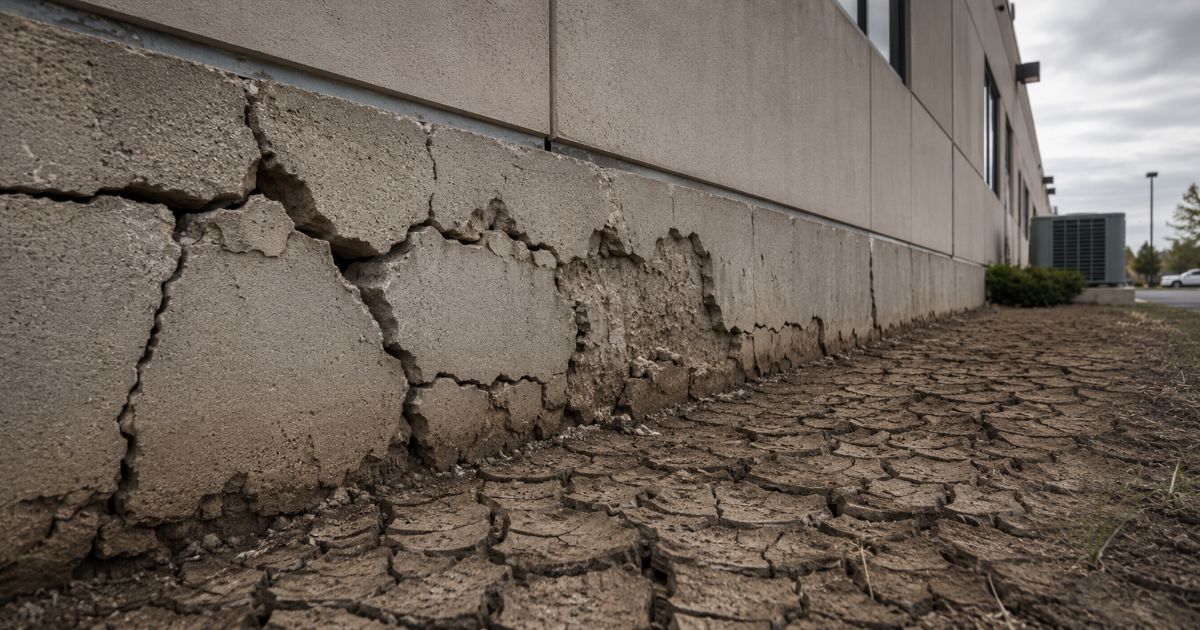
Clay minerals have a layered crystalline structure with a strong electrochemical affinity for water molecules. As water enters the clay mineral lattice, the layers separate and soil volume increases, high-plasticity clays found across the American South, Texas, and Arizona can expand 30-40% in volume between dry and saturated states. When that expansion occurs non-uniformly beneath a foundation, the differential movement creates shear stress in the foundation structure. The reverse process, contraction during drying, is equally damaging, pulling the soil away from the foundation and leaving voids that remove the bearing support the foundation was designed to rest on.
Stage 1, Extended dry period. Precipitation below seasonal norms, above-average temperatures, or both. The soil moisture reservoir begins depleting. Rate of depletion varies by zone based on exposure, drainage, and soil composition.
Stage 2, Differential drying. High-exposure zones dry faster than shaded zones. Zones near large trees dry fastest. The moisture profile around the foundation perimeter becomes asymmetric. This is invisible from above.
Stage 3, Soil shrinkage and void formation. Moisture content falls below the shrinkage limit of the clay. The soil begins contracting. In the fastest-drying zones, voids begin forming beneath and beside the foundation elements. The foundation loses bearing support in localized areas.
Stage 4, Differential settlement. Foundation elements that have lost bearing support begin to move. Elements in better-supported zones don't. The differential movement, even a few millimeters, creates tension in the concrete or masonry. Cracks begin forming at stress concentration points: corners of openings, construction joints, beam-to-wall connections.
Stage 5, Visible damage. Cracks become visible. Doors and windows begin sticking or racking. Floors develop perceptible slope. At this point the damage has been developing for months.
Stage 6, Rebound damage. When rain arrives after the drought, the dry soil, now containing voids and gaps, rehydrates rapidly and unevenly. The rapid moisture swing from severely dry to saturated creates a new round of differential movement. In many cases the rebound event causes more acute damage than the original drying.
Frequently Asked Questions
How deep do the sensors need to be to detect the moisture changes that cause foundation damage?
The soil movement that stresses foundations occurs at the depth where the clay layer is actively cycling between wet and dry, typically 3-6 feet below grade on most residential and light commercial properties. RS-485 Modbus probe cables extend up to 20 feet depth, enabling measurement at the precise depth relevant to the structure's foundation elements.
Can the system detect whether soil voids have already formed?
Soil moisture sensors detect moisture content, not physical voids directly. However, a moisture reading persistently lower than adjacent zones and lower than historical seasonal norms for that zone is a reliable indicator of compromised drainage or subsurface void formation, a trigger for physical inspection rather than purely automated response.
What's the difference between this and a standard weather-based irrigation controller?
A weather-based controller adjusts a preset schedule based on precipitation and temperature. It doesn't measure actual soil conditions at depth, doesn't track zone-level differential behavior, doesn't model moisture trajectories, and doesn't integrate multi-day weather forecasts into a predictive risk model. It's a timer with a weather modifier, not a soil moisture management platform.
Do I need to do anything manually once the system is deployed?
Routine operation is fully automated, sensor monitoring, AI analysis, irrigation actuation, and alert generation require no manual intervention. The recommended human activities are reviewing the dashboard periodically to confirm normal operation, investigating zones that generate anomaly alerts, and checking physical sensor condition during seasonal maintenance.
How does the system handle multiple structures on the same property?
Each structure has its own sensor perimeter, configured as a named zone group in the cloud platform. The dashboard presents a property-level view showing all structures and their current status, with drill-down to individual sensor zones. A single Hub can support sensor networks for multiple structures if they're within LoRa range.
Learn more about Drip Defender →
Related: Why Foundation Watering Systems Fail | From Reactive to Proactive: The Economics of Foundation Protection