
Telemetry Insights
InsightsThe Hidden Cost of Expansive Clay Soil: What Every Commercial Property Manager Needs to Know

The Hidden Cost of Expansive Clay Soil: What Every Commercial Property Manager Needs to Know

Stephen Harris · Founder & CEO, Telemetry InsightsNovember 2025
clay soilfoundation damagecommercial propertysoil moistureIoT
The Hidden Cost of Expansive Clay Soil: What Every Commercial Property Manager Needs to Know

Published by Telemetry Insights | November 2025


The American Society of Civil Engineers estimates that expansive soils cause more property damage in the United States annually than floods, hurricanes, tornadoes, and earthquakes combined. The number approaches $15 billion per year, and the vast majority of it is preventable.

Commercial property managers deal with this risk every day, often without knowing it. The damage is slow, invisible, and cumulative. By the time it shows up as a crack in a load-bearing wall, a misaligned storefront door, or a structural engineer's report, the soil has been working on the foundation for months or years.


What Expansive Clay Soil Actually Does

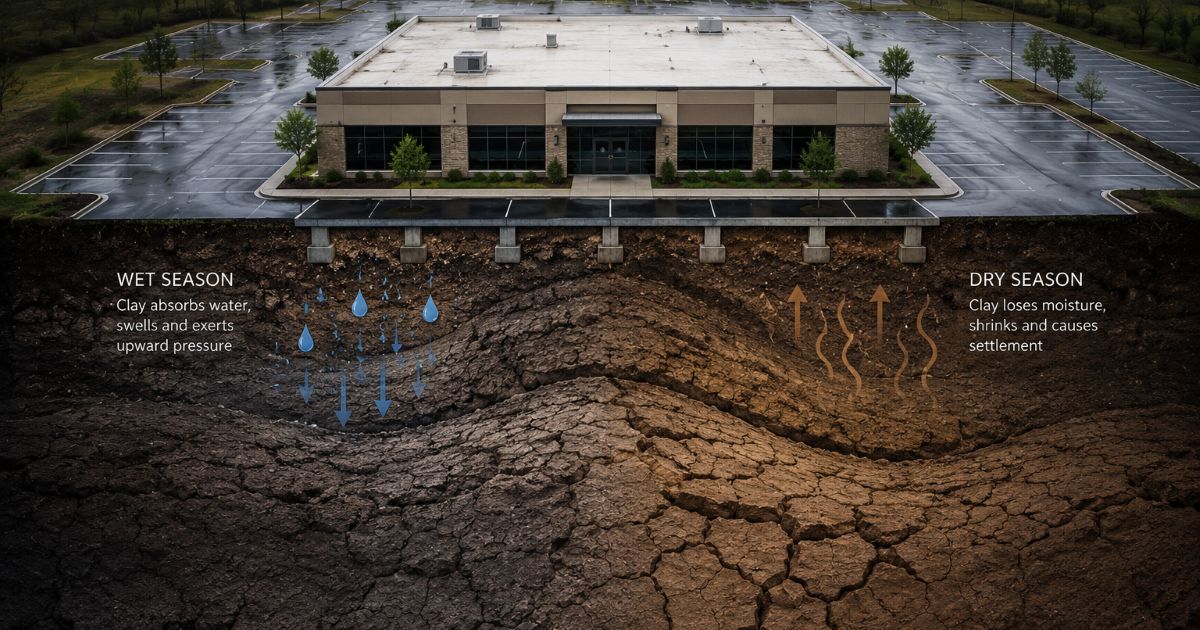
Clay soil contains minerals, primarily montmorillonite and illite, with a strong affinity for water molecules. When clay absorbs water it expands, sometimes dramatically. When it dries out it contracts, and on high-clay soils the shrinkage can be severe enough to create voids and gaps beneath and around foundation elements.

The expansion-contraction cycle exerts force on whatever is in contact with the soil. For a commercial foundation, slab, pier-and-beam, or spread footing, that force translates to uplift during wet periods and differential settlement during dry periods. When different zones of a foundation move at different rates, the structure above experiences shear stress. That stress eventually exceeds the tensile strength of concrete, masonry, or framing connections.

The process is invisible until it isn't. A foundation that has been experiencing differential movement for two years may look fine until one season's moisture event pushes it past the failure threshold.


The Commercial Property Risk Profile

Commercial properties face specific risk factors that residential properties don't, or face less severely.

Larger footprints mean more perimeter exposure. A 20,000 square foot commercial building has far more foundation perimeter exposed to soil variation than a residential house. Different sides face different sun exposure, drainage patterns, and potentially different soil composition, driving asymmetric moisture behavior. The north side may be consistently moister than the south side, creating chronic differential movement even without extreme weather.

Impervious surface coverage concentrates moisture movement. Commercial properties typically have high ratios of impervious surface, parking lots, drive approaches, loading areas. These prevent rainfall from infiltrating the soil beneath them, forcing surface runoff to concentrate at the edges where it meets the building foundation. This creates localized saturation zones adjacent to perpetually dry soil under the hardscape, exactly the asymmetric moisture profile that drives differential settlement.

Deferred maintenance compounds risk. Residential owners often notice foundation symptoms because they live in the building. Commercial tenants report symptoms inconsistently. Property managers often don't discover foundation movement until a lease inspection or capital planning review, by which point remediation costs are substantially higher than early intervention would have been.

Insurance and warranty exposure. Commercial property insurance policies often exclude gradual foundation damage caused by soil movement. Warranty claims on newer construction require documentation of soil conditions. Without a continuous monitoring record, establishing causation becomes a dispute rather than a data exercise.


What Continuous Monitoring Changes

A commercial property with a deployed IoT soil moisture sensor network has visibility that changes the risk profile entirely.

Each sensor zone delivers continuous moisture readings, temperature data, and historical trend lines accessible from a cloud dashboard. The AI platform monitors rate-of-change across all zones simultaneously, identifies asymmetric behavior indicating a localized drainage or soil problem, and triggers alerts before conditions reach structural risk levels.

The operational impact is threefold. First, intervention happens early, when irrigation or drainage correction costs hundreds of dollars rather than structural remediation costing tens of thousands. Second, the property manager has a documented moisture history supporting insurance claims, warranty disputes, and due diligence disclosures in property transactions. Third, predictive alerts based on weather forecast integration mean the team knows about developing risk conditions before the risk materializes.

For a property manager with a portfolio of properties, the monitoring platform scales across all sites through a single dashboard. Anomalies surface automatically. Properties that need attention are flagged without manual review of each site.


The Cost Comparison

Foundation repair costs for commercial properties are not small numbers.

  • Minor crack repair and waterproofing: $5,000–$25,000
  • Moderate differential settlement requiring pier installation: $25,000–$100,000
  • Severe structural remediation involving excavation or underpinning: $100,000–$500,000+

These figures don't include business interruption costs, tenant displacement, or the depreciation in property value that follows a documented structural event.

A full-perimeter IoT sensor deployment for a mid-size commercial building, 8-12 sensor nodes, hub, installation, and cloud subscription, is a rounding error against those numbers. The ROI calculation is straightforward. The question is whether the monitoring is in place before or after the damage event.


Frequently Asked Questions

How many sensors does a commercial building typically need?

A typical mid-size commercial building requires 8-12 sensor nodes for full perimeter coverage, one at each corner, one at each mid-span on longer walls, and additional nodes at high-risk zones like loading dock areas, downspout discharge points, and areas with known drainage issues. The hub-and-node LoRa architecture scales coverage without wiring.

Does monitoring work on existing buildings or only new construction?

Monitoring works on any building at any stage. Existing buildings with known foundation history actually benefit most immediately, the sensor data establishes a current baseline and identifies whether any active movement is occurring, providing a defensible starting point for maintenance planning.

Can soil moisture monitoring replace regular structural inspections?

No, they serve different purposes. Structural inspections assess existing conditions. Continuous soil moisture monitoring prevents future conditions from developing. Both are appropriate components of a commercial property maintenance program. Monitoring data also makes inspections more targeted and efficient by flagging specific zones for closer examination.

What's the liability exposure for a commercial property manager who doesn't monitor?

This varies by jurisdiction and lease structure. In some commercial lease arrangements, the property manager's obligation to maintain structural integrity creates exposure if preventable damage occurs and no monitoring was in place. The trend in commercial real estate risk management is clearly toward documented, proactive monitoring programs.


Learn more about Drip Defender → Related: Why Foundation Watering Systems Fail | From Reactive to Proactive: The Economics of Foundation Protection


The Hidden Cost of Expansive Clay Soil: What Every Commercial Property Manager Needs to Know | Insights | Telemetry Insights | Telemetry Insights