Telemetry Insights
InsightsFrom Reactive to Proactive: How Predictive AI Changes the Economics of Commercial Foundation Protection

From Reactive to Proactive: How Predictive AI Changes the Economics of Commercial Foundation Protection

Stephen Harris · Founder & CEO, Telemetry InsightsApril 2026
predictive AIfoundation protectioncommercial real estateROIDrip Defender
From Reactive to Proactive: How Predictive AI Changes the Economics of Commercial Foundation Protection

Published by Telemetry Insights | April 2026


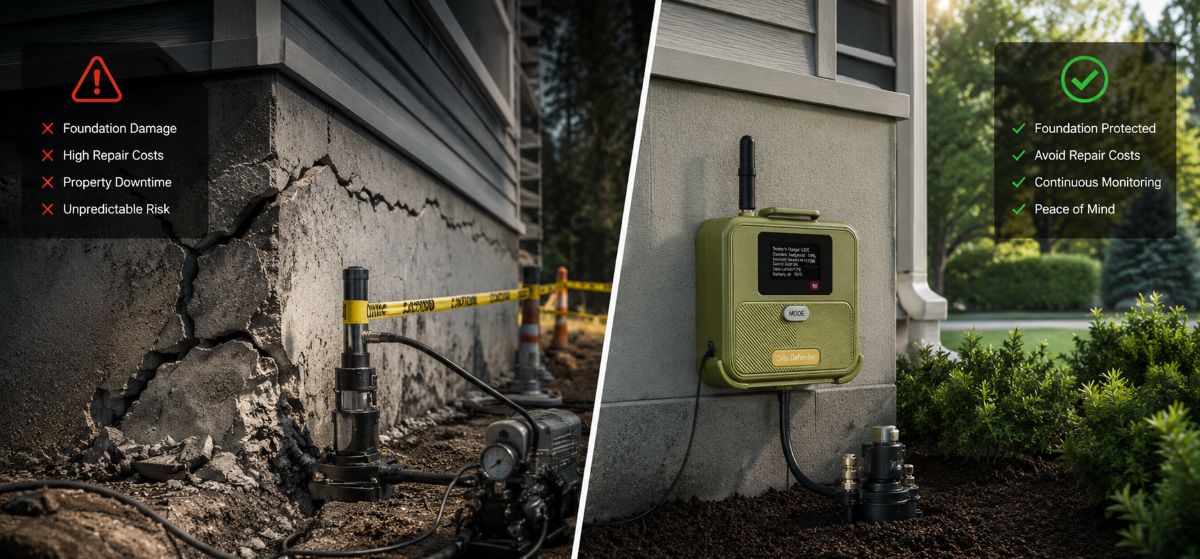
The commercial real estate industry has a standard model for foundation risk management: inspect periodically, repair when damage is discovered, and treat structural events as capital expenditures to be budgeted reactively. It's the same model applied to most building systems, run to failure, then fix, and it's expensive in ways that don't always show up clearly in the maintenance budget.

The alternative, continuous monitoring with predictive AI, has a different economic structure. Lower intervention costs. Smaller capital exposure. Documented risk reduction. A maintenance record that is an asset rather than a liability in property transactions.

The economics of the shift are not ambiguous. The barrier has been access: until recently, the sensor infrastructure and AI platforms required to operate proactively at commercial scale were either unavailable or priced for enterprise deployments only. That barrier is gone.


The True Cost of Reactive Foundation Management

The repair cost of a foundation event is the number that appears in the capital budget. It's not the true cost.

Add tenant disruption, lost rent during remediation, potential lease termination rights triggered by habitability issues, concessions to retain tenants through a disruptive repair period. Add the depreciation in property value that follows a documented structural event, even after successful remediation. Add the legal exposure if a tenant or employee is injured as a result of structural failure. Add the insurance premium implications if a claim is filed.

For a mid-size commercial property, a single significant foundation event, $50,000 to $150,000 in direct repair cost, typically generates 2-4x that figure in total economic impact when indirect costs are fully accounted for.

Against that, continuous perimeter monitoring costs a fraction of one repair event annually. The ROI calculation requires only that the probability of a preventable damage event over a multi-year period be greater than trivially small, which, for commercial properties on expansive clay soil in the American South and Southwest, it is not.


How Predictive AI Works in Practice

Predictive AI for foundation protection operates on a simple principle: the conditions that cause foundation damage are detectable weeks before the damage occurs. Acting on early detection costs orders of magnitude less than remediating the damage.

The cloud AI platform continuously monitors several leading indicators simultaneously.

Moisture rate-of-change. Not the current moisture level, the trajectory. Soil drying at 1.5% volumetric water content per day during a period of above-normal temperatures, with no rain forecast for 10 days, is a structural risk condition even if the current absolute moisture level hasn't crossed a threshold yet. The AI identifies the trajectory and triggers response while intervention is still low-cost.

Asymmetric behavior across zones. A foundation perimeter where three sensor zones are behaving consistently with seasonal expectations and one zone is diverging significantly is flagging a localized condition, a drainage change, a failed emitter, a tree root absorbing moisture, that will drive differential settlement if not addressed. Continuous AI monitoring flags it in real time.

Weather forecast integration. Multi-day drought forecasts integrated with current soil moisture and depletion rate models generate a predicted time-to-risk for each zone. The platform knows today that zone 4 will reach the irrigation trigger threshold in 6 days if no rain falls, and initiates proactive watering to prevent that outcome.

Historical baseline deviation. The AI maintains a seasonal baseline for every sensor zone based on accumulated historical data. Conditions that deviate significantly from the historical pattern for this time of year, even if they don't yet meet an absolute alert threshold, surface as anomalies worth investigating.


The Documentation Value

Beyond damage prevention, continuous monitoring generates a property record with independent value in commercial real estate transactions and risk management.

A property with 18 months of continuous foundation moisture history, showing stable seasonal behavior, no anomalous events, and consistent automated maintenance response, is a fundamentally different asset from an identical property with no monitoring history. The record demonstrates active stewardship, provides a baseline for any future structural assessment, and eliminates the "unknown condition" uncertainty that causes buyers and lenders to apply risk discounts.

For property managers operating under institutional mandates to document risk management programs, continuous IoT monitoring provides the audit trail that periodic inspections alone cannot, every sensor reading, every alert, every automated irrigation response, timestamped and exportable.


The Economics Summary

Reactive ModelProactive Model
DetectionAfter visible damageWeeks before damage threshold
Intervention cost$50K–$500K structural repair$500–$5K irrigation or drainage correction
Data recordInspection reports, periodicContinuous timestamped sensor history
Insurance postureEvent-driven claimsDocumented risk management program
Property value impactNegative after repair historyPositive from demonstrated stewardship
Annual monitoring cost$0 until event$1,200–$4,800 hardware + subscription

Frequently Asked Questions

What's the typical ROI timeline for a commercial foundation monitoring deployment?

Most commercial properties recoup deployment costs within the first prevented damage event, which, on expansive clay soil, typically occurs within a 2-5 year window without monitoring. Properties post-remediation see immediate ROI from preventing recurrence, which is the highest-probability damage scenario.

Does insurance pricing reflect the presence of a monitoring system?

This varies by insurer and policy structure. Some commercial property insurers offer premium reductions for documented continuous monitoring programs. More broadly, the documented risk management record strengthens the property's position in any coverage dispute or claim.

How does predictive AI perform in the first year before it has accumulated historical baseline data?

The platform uses climate-normals and property-specific seasonal patterns from the first season of data to establish initial baselines. Absolute threshold alerts operate from day one. Baseline-deviation alerts improve as historical data accumulates. Most customers see meaningful baseline models established within 90-120 days of deployment.

Can the monitoring system integrate with an existing property management platform?

The TI platform provides API access to sensor data, alert history, and irrigation event logs. Integration with property management software and CMMS systems is supported via REST API.


Learn more about Drip Defender → Related: The Hidden Cost of Expansive Clay Soil | How Soil Moisture Destroys Foundations


From Reactive to Proactive: How Predictive AI Changes the Economics of Commercial Foundation Protection | Insights | Telemetry Insights | Telemetry Insights