Telemetry Insights
InsightsSmart Irrigation for Commercial Agriculture: How Sensor-Driven Platforms Replace Scheduling Guesswork

Smart Irrigation for Commercial Agriculture: How Sensor-Driven Platforms Replace Scheduling Guesswork

Stephen Harris · Founder & CEO, Telemetry InsightsJanuary 2026
smart irrigationcommercial agricultureIoTsoil moistureWater Buddi
Smart Irrigation for Commercial Agriculture: How Sensor-Driven Platforms Replace Scheduling Guesswork

Published by Telemetry Insights | January 2026


Commercial irrigation scheduling is one of the more consequential decisions in agricultural operations, and it's one that most operations still make with inadequate information. The calendar says Tuesday, Thursday, and Saturday. The timer fires. The water runs. Whether the soil at root depth in zone 7 actually needed water that day, or needed twice as much, the schedule doesn't know and can't find out.

The consequences run in both directions. Under-irrigation stresses crops during critical growth stages, reducing yield and quality. Over-irrigation leaches nutrients below the root zone, promotes root disease, drives up water and pumping costs, and in regulated watersheds creates compliance exposure. Both failure modes are chronic on properties running fixed schedules, because the schedule is designed around a worst-case assumption and applied uniformly to soil that is never uniform.

Sensor-driven platforms replace the schedule with data. The difference in outcomes is not marginal.


The Problem With Scheduling

A fixed irrigation schedule is an engineering approximation. Someone estimated how much water the crop needs per week at this growth stage, divided it into sessions that fit the available equipment capacity, and programmed a controller.

What it didn't account for: this week's actual evapotranspiration rate, which varies with temperature, humidity, wind speed, and solar radiation and can differ from the seasonal average by 30-40% during heat events. The actual current soil moisture at root depth in each zone. The rainfall that fell yesterday and hasn't finished infiltrating. The drainage differential between the sandy loam in the east field and the clay in the west field. The localized dry pocket in zone 12 that nobody noticed because it looks fine from the surface.

Every one of these factors is measurable. None of them are accounted for in a fixed schedule.


What Sensor-Driven Irrigation Actually Measures

A properly deployed commercial soil moisture sensor network delivers several data streams that a schedule-based system doesn't have.

Volumetric water content at root depth. Not surface moisture, moisture at the depth where roots actually take up water. For most row crops this is 12-24 inches. For tree crops and vines it extends deeper. The sensor data shows actual available water in the root zone, zone by zone, in real time.

Soil temperature. Root activity, nutrient uptake efficiency, and microbial activity all vary with soil temperature. Irrigation timing and volume decisions informed by soil temperature are more precise than those based on air temperature alone.

Rate of moisture depletion. How fast is the soil drying out in each zone? A zone depleting at 2% per day needs water sooner than one depleting at 0.5% per day. Rate-of-change data enables predictive irrigation scheduling, triggering irrigation before stress occurs rather than after.

Zone-to-zone variation. On a 200-acre property, soil composition, drainage, sun exposure, and crop stage vary. A single sensor per property misses all of this. A multi-zone network captures it, enabling variable-rate irrigation decisions that match water delivery to actual zone-level demand.


ET₀ Integration: Matching Water Supply to Crop Demand

Sensor data tells you what the soil has. Penman-Monteith evapotranspiration modeling tells you what the crop is spending.

ET₀, reference evapotranspiration, is a calculated estimate of the water demand placed on the soil by current atmospheric conditions: temperature, humidity, wind speed, and solar radiation. Applied to a specific crop with a known crop coefficient, it produces a daily crop water demand estimate that reflects actual conditions rather than seasonal averages.

A cloud AI platform combining real-time ET₀ calculations with sensor-measured soil moisture can determine, for each zone, the current soil water deficit relative to the crop's optimal level, and calculate exactly how much irrigation is needed to close that deficit. This is materially different from running a schedule. It's calculating a water balance and filling it precisely.

Published field trial results using ET₀-integrated sensor platforms consistently report 20-40% water savings compared to fixed-schedule irrigation, with maintained or improved yield outcomes. The savings aren't from cutting corners, they're from eliminating the chronic over-irrigation that fixed schedules embed as a safety margin.


Automated Actuation: Closing the Loop

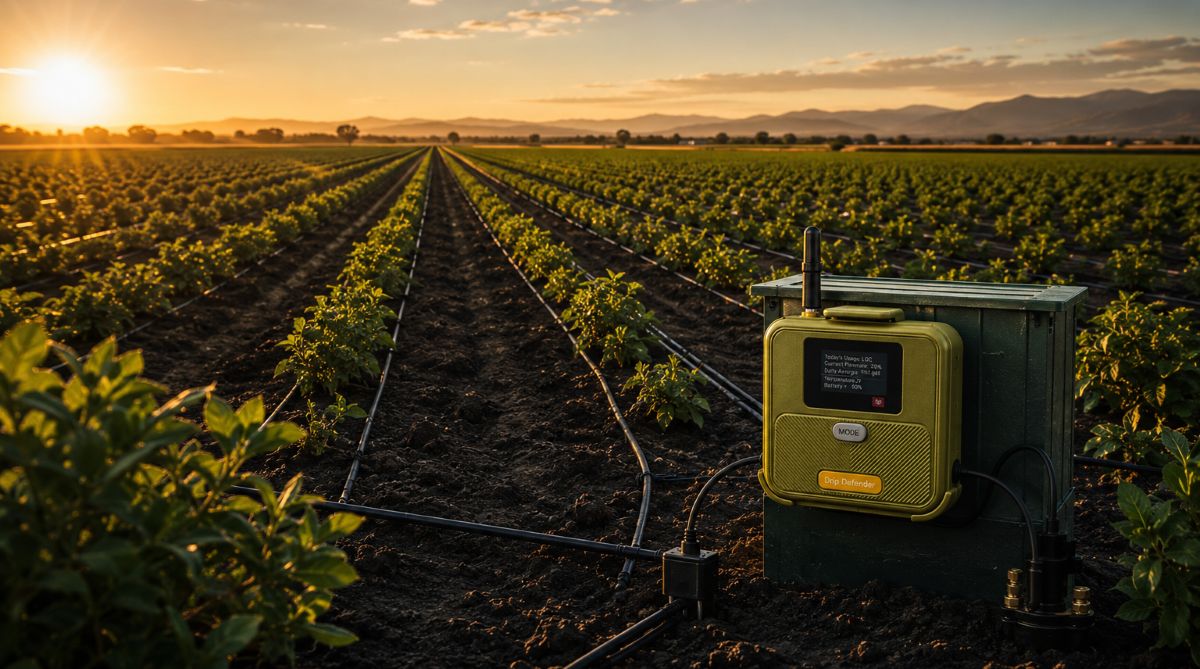
Measurement without actuation is just monitoring. The platform that delivers operational value combines soil moisture sensing and ET₀ modeling with direct control of irrigation valves.

When the cloud AI determines that zone 7 has reached the irrigation trigger threshold, soil moisture below the crop-specific threshold, ET₀ deficit accumulating, no rainfall forecast in the next 48 hours, it opens the zone 7 valve, runs the calculated irrigation volume, closes the valve, and logs the event. No operator intervention. No schedule override. No manual dashboard review.

The human role in this architecture shifts from executing irrigation decisions to reviewing outcomes and managing exceptions. Operators see a dashboard showing every zone's current status, recent irrigation history, and upcoming predicted needs. They intervene when something is anomalous. The routine work runs autonomously.


Frequently Asked Questions

What crops and operation types benefit most?

High-value crops, tree fruits, wine grapes, vegetables, nursery stock, turf, see the highest ROI because water savings and yield quality improvements have the most economic impact. Row crop operations benefit primarily from water cost reduction and regulatory compliance documentation. All operation types with zone-variable soil conditions benefit from per-zone data.

How does the platform handle rainfall?

Rain sensor and weather station integration allow the platform to account for actual rainfall and adjust irrigation accordingly. ET₀ calculations incorporate precipitation data. Zones that received adequate natural rainfall are bypassed on the irrigation cycle without manual intervention.

What's the minimum viable sensor density?

The minimum useful deployment is one sensor per distinct soil zone, areas with meaningfully different soil type, drainage, or crop stage. For many operations this means 4-8 sensors across a field. The step-change in value comes from getting zone-level data at all, versus the single-schedule approximation.

How does sensor-driven irrigation interact with water rights and regulatory compliance?

Sensor data and irrigation event logs provide the documented record that regulators increasingly require for water use reporting. In water-restricted regions, sensor-driven platforms that demonstrably reduce water consumption support variance requests and priority allocations. The audit trail is an operational asset beyond irrigation efficiency alone.


Learn more about Water Buddi → Related: ET₀ Modeling and AI: The Science Behind Water-Efficient Irrigation | How AI, ML, and IoT Are Rewriting Soil Moisture Management


Smart Irrigation for Commercial Agriculture: How Sensor-Driven Platforms Replace Scheduling Guesswork | Insights | Telemetry Insights | Telemetry Insights