
Telemetry Insights
InsightsET₀ Modeling and AI: The Science Behind Water-Efficient Irrigation at Commercial Scale

ET₀ Modeling and AI: The Science Behind Water-Efficient Irrigation at Commercial Scale

Stephen Harris · Founder & CEO, Telemetry InsightsFebruary 2026
ET0evapotranspirationirrigationAIcommercial agricultureWater Buddi
ET₀ Modeling and AI: The Science Behind Water-Efficient Irrigation at Commercial Scale

Published by Telemetry Insights | February 2026


Most irrigation controllers sold today have a weather adjustment feature. You enable it, connect it to a weather service, and it reduces your scheduled run times by some percentage on days after it rains. It's presented as smart irrigation. It isn't.

The gap between a weather-adjusted timer and a true evapotranspiration-driven irrigation platform is the difference between a rough approximation and an actual water balance calculation. For commercial agricultural operations managing water costs, crop quality, and regulatory compliance simultaneously, that gap is worth understanding precisely.


What Evapotranspiration Actually Measures

Evapotranspiration (ET) is the combined water loss from a system through two processes: evaporation from the soil surface and transpiration from plant tissue. It represents the actual water demand placed on the soil by the combination of atmospheric conditions and crop biology.

ET varies continuously with temperature, solar radiation, wind speed, and relative humidity. On a hot, dry, windy day with high solar load, a commercial crop may transpire 3-4 times as much water as on a cool, overcast, humid day. A fixed irrigation schedule calibrated for average summer conditions will chronically under-irrigate during heat events and chronically over-irrigate during mild periods.

Reference evapotranspiration (ET₀) is a standardized calculation of this water demand for a reference crop, typically a well-watered grass surface, under actual atmospheric conditions. The Penman-Monteith equation, endorsed by the UN Food and Agriculture Organization as the global standard, calculates ET₀ from temperature, humidity, wind speed, and solar radiation data. Multiplying ET₀ by a crop-specific coefficient (Kc) gives actual crop evapotranspiration, the precise water demand for the specific crop at its current growth stage.


Why This Matters More Than Weather Adjustment

A weather-adjusted timer reduces run time after rainfall. That's the extent of its adaptation. It doesn't calculate water demand. It doesn't know the crop coefficient. It doesn't account for the difference in ET₀ between a 95°F day with 20% humidity and a 95°F day with 60% humidity, which is a meaningful difference in crop water demand.

ET₀-driven irrigation calculates the actual water deficit in the soil relative to the crop's optimal level and delivers precisely the volume needed to close that deficit. The calculation runs continuously, incorporating real-time weather data, and the irrigation trigger is based on the accumulated deficit exceeding the crop-specific stress threshold, not a calendar schedule.

The operational result is that irrigation events happen when the crop needs water, in the volume the crop needs, regardless of what day of the week it is. Some weeks that means irrigating more frequently than the schedule would have. Many weeks it means irrigating substantially less.


How Cloud AI Integrates ET₀ With Sensor Data

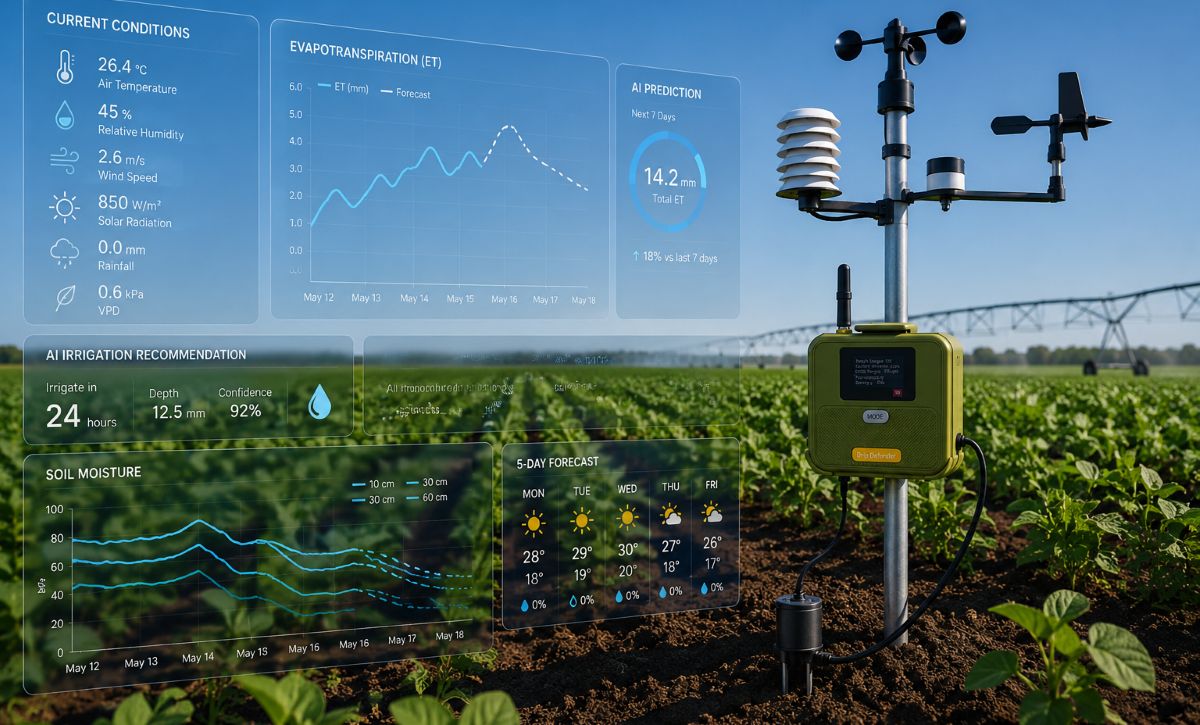
ET₀ modeling gives you the atmospheric demand side of the water balance. Soil moisture sensors give you the current supply side. Cloud AI combines them.

The TI cloud platform continuously calculates ET₀ from live weather API data, temperature, humidity, wind, solar radiation updated at sub-hourly intervals. Simultaneously, RS-485 soil moisture sensors report current volumetric water content at root depth in each irrigation zone. The AI maintains a running water balance for each zone: current soil moisture minus ET₀ depletion rate, adjusted for any rainfall, equals the current available water in the root zone.

When available water in a zone falls below the crop-specific lower trigger threshold, typically 50-60% of field capacity for most commercial crops, the platform initiates an irrigation event sized to refill the zone to the upper trigger threshold. The valve opens, runs the calculated volume, closes, and the event is logged.

This is a closed-loop control system. Sensor data confirms the soil state. ET₀ modeling predicts the depletion rate. The AI executes the actuation. The outcome is a soil moisture trajectory that stays within the optimal band continuously rather than spiking at irrigation events and dropping until the next scheduled run.


The Research Foundation

The ET₀-driven approach is the most heavily researched irrigation methodology in precision agriculture and the basis of most published water savings data.

LSTM-based cloud AI models trained on multi-year ET₀ and soil sensor datasets are achieving 7-day crop water demand forecasts with mean absolute errors below 0.02 m³/m³, accurate enough to plan irrigation schedules a week ahead based on forecast conditions. This enables pre-positioning soil moisture before predicted heat events and reducing irrigation ahead of predicted rainfall, optimizing the water balance proactively rather than reactively.

Published field trial results across multiple crop types and climates consistently show 20-40% water reduction versus fixed-schedule irrigation using ET₀-integrated sensor platforms, with no yield loss and in many cases improved fruit quality from better-controlled mild water stress during maturation.


Frequently Asked Questions

What weather data sources does ET₀ calculation require?

The Penman-Monteith equation requires air temperature (max and min), relative humidity, wind speed, and solar radiation. The TI platform integrates with the Visual Crossing weather API, providing these parameters at sub-hourly intervals for any location globally. On-site weather stations can be integrated for higher local accuracy.

How does ET₀ modeling handle different crop types and growth stages?

Each crop has a published crop coefficient (Kc) curve that varies by growth stage, initial, development, mid-season, and late-season. The platform applies the appropriate Kc based on crop type and planting date, automatically adjusting as the season progresses. Custom Kc curves can be configured for specific cultivars or local conditions.

Is ET₀-based irrigation suitable for drip, overhead, and subsurface systems?

Yes, ET₀ modeling calculates water demand independently of delivery method. The irrigation volume calculation accounts for the application efficiency of the delivery method (drip systems typically 90%+ efficient; overhead systems 70-85%) to ensure the right volume reaches the root zone regardless of how it's delivered.

How quickly does the water savings materialize after deployment?

Most operations see measurable water reduction in the first full irrigation season. The magnitude depends on how far the previous schedule was from optimal. Year 2 typically shows further improvement as the AI accumulates site-specific historical data and model accuracy improves.


Learn more about Water Buddi → Related: Smart Irrigation for Commercial Agriculture | How AI, ML, and IoT Are Rewriting Soil Moisture Management


ET₀ Modeling and AI: The Science Behind Water-Efficient Irrigation at Commercial Scale | Insights | Telemetry Insights | Telemetry Insights