Published by Telemetry Insights | September 2025
Every foundation contractor in Texas will tell you the same thing: keep the soil moisture consistent and you'll avoid most of the expensive problems. Every commercial irrigation manager will say something nearly identical: stop guessing about water and start measuring it. For decades, both groups have been solving the same core problem with the same inadequate tools, manual checks, fixed-schedule timers, and reactive repairs after the damage is already done.
That era is ending.
The convergence of AI, machine learning, IoT sensor networks, and cloud intelligence has produced a fundamentally different capability for soil moisture management, one that doesn't react to problems but anticipates and prevents them. This isn't incremental improvement. It's a categorical shift in what's possible, and it matters equally whether you're protecting a $500,000 commercial foundation or optimizing irrigation across 200 acres of clay soil.
The Technology Stack That Changes Everything
Continuous Multi-Depth Sensor Networks
The first requirement for intelligent soil moisture management is data, not daily readings, not weekly spot checks, but continuous, high-frequency measurements across the full soil profile.
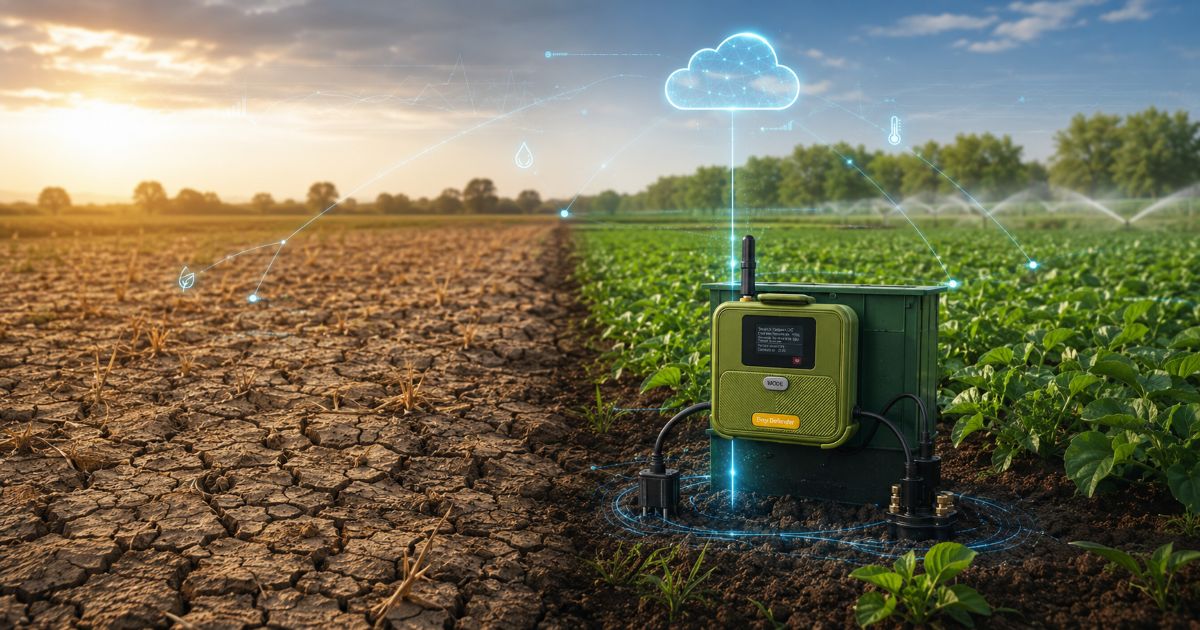
Modern RS-485 Modbus soil sensors, deployed at multiple depths around a foundation perimeter or across commercial field zones, deliver exactly this. Where a homeowner with a handheld moisture meter might check three spots once a week, a properly deployed IoT sensor network captures readings every few minutes from every critical zone simultaneously. For foundation protection, that means full perimeter coverage, corners, mid-spans, and the deep soil layers where moisture changes drive the most structural stress. For agriculture, it means per-zone coverage at root-zone depth, capturing the actual moisture content where it matters for crop uptake.
The hardware has matured significantly. Current capacitive soil sensors achieve accuracy within ±2-3% volumetric water content. Combined with onboard air temperature, humidity, and barometric pressure measurement, a single well-placed device creates a rich, multi-variable data stream that no manual inspection can replicate.
LoRa Mesh Networking: Range Without Infrastructure
Wiring sensors across a commercial property used to mean either expensive trenching or compromising on coverage. Long Range (LoRa) wireless mesh networking has eliminated that constraint entirely.
LoRa operates in the sub-GHz band, achieving reliable ranges of 1 kilometer or more with minimal power consumption. In a mesh architecture, one hub device serves as the WiFi gateway to the cloud platform while simultaneously acting as a long-range radio bridge for up to 32 additional sensor nodes. Each node runs on battery backup for up to 24 hours even during power outages, and the mesh self-heals if any individual node goes offline.
For a commercial building with a large foundation perimeter, or an agricultural operation spanning multiple fields, this means full sensor coverage without running a single additional cable. The hub goes where WiFi exists; the nodes go where the measurements need to happen.
Recent peer-reviewed research published in Sensors (2025) demonstrated LoRaWAN-connected soil sensor networks achieving data transmission latency under 5 seconds while extending sensor battery life beyond 5 years, a meaningful operational benchmark for any deployment that needs to run without constant maintenance attention.
Cloud AI: Where the Intelligence Lives
The sensor network's job is to measure and transmit, continuously, reliably, at scale. The cloud platform's job is to think.
This division of labor is deliberate. IoT devices on a foundation perimeter or across an agricultural field are optimized for low power, long range, and environmental durability. The AI, trend detection, predictive modeling, weather integration, anomaly scoring, automated response logic, runs in the cloud where compute, data history, and model complexity face no embedded hardware constraints.
A cloud AI platform continuously ingesting soil moisture time-series data can identify patterns that no threshold alarm and no human review would catch. Rapid drying rate after a heat event, not yet at a dangerous absolute level, but accelerating toward one, triggers a predictive alert before the critical threshold is reached. Asymmetric drying across a foundation perimeter flags a localized drainage problem invisible to the naked eye. Correlation between weather forecast data and historical moisture response allows the platform to pre-position soil conditions ahead of a predicted multi-day drought rather than reacting after the damage window has opened.
This architecture also means the intelligence improves over time. As more sensor data accumulates, models retrain against a richer history. Seasonal baselines sharpen. Anomaly detection becomes more precise. The platform gets better at the specific property it's monitoring without any user intervention.
Research from the University of Calabria catalogued 68 peer-reviewed studies tracking the progression of cloud and hybrid AI approaches for soil moisture forecasting, from simple threshold models to LSTM and Transformer architectures, confirming that cloud-based inference is the production-proven path for systems requiring the accuracy and depth that structural protection and commercial agriculture demand.
For commercial agriculture, cloud AI enables Penman-Monteith evapotranspiration (ET₀) modeling, the gold standard for calculating actual crop water demand based on temperature, humidity, wind speed, and solar radiation. ET₀-driven irrigation scheduling consistently outperforms calendar-based or even simple threshold-based approaches, delivering 20-40% water savings in published field trials without yield compromise.
The architecture that delivers this cleanly is a multi-layer ML stack: time-series forecasting at the sensor edge, anomaly detection and ET₀ modeling in the cloud inference layer, and a continuous write-back loop that pushes automated response commands (open valve, send alert, update schedule) back to the field hardware. No human in the loop required for routine operations.
Digital Twins and Spatial Modeling
Beyond individual sensor readings, advanced deployments are now building digital twin models of the soil environment, spatial representations that combine sensor data, GPS coordinates, soil type characterization, historical weather, and topographic data into a unified model of the property.
A foundation digital twin shows not just current moisture levels at each sensor location, but the interpolated moisture gradient across the entire perimeter, the predicted behavior of each soil zone under the next 7-day weather forecast, and the historical trend line for each sensor going back to installation. When a contractor or property manager pulls up the dashboard, they're not reading a list of numbers, they're looking at a living model of what the ground is doing and what it's about to do.
For commercial agriculture, spatial modeling enables variable-rate irrigation, applying different water volumes to different zones based on their actual soil type, crop stage, and current moisture deficit. Research published in Smart Agricultural Technology (April 2026) confirmed 94% prediction accuracy and 24% energy savings in field trials using optimized wireless sensor networks combined with spatial ML models.
Frequently Asked Questions
Can AI really prevent foundation damage, or does it just detect it earlier?
Both. Detection is faster, a well-tuned cloud AI platform identifies dangerous moisture trajectories days before conditions reach critical levels, giving time for automated or manual response. Prevention is real when the platform is paired with automated irrigation: the system actively maintains soil moisture within the target band rather than alerting after it's drifted out of range.
How many sensors do I need for effective foundation protection?
For a typical residential or light commercial building, 4-6 sensor nodes covering the full perimeter, corners plus mid-span on longer walls, provides complete coverage. For larger commercial buildings, the hub-and-node architecture scales to 32 nodes per hub with no additional wiring infrastructure required.
What's the difference between how the sensors and the cloud AI work?
The sensors measure and transmit, continuously collecting soil moisture, temperature, and environmental data and sending it to the cloud platform over WiFi or LoRa. The cloud AI does the thinking: trend detection, predictive modeling, weather integration, anomaly scoring, and automated response commands sent back to field hardware. This cloud-first architecture means the AI runs with no embedded hardware constraints, improves as data accumulates, and can be updated without touching a single device in the field.
How does weather forecast integration improve foundation protection?
Weather-integrated platforms can anticipate soil moisture stress before it develops. A 7-day drought forecast triggers proactive irrigation to build a moisture reserve in the soil before drying begins, preventing the dangerous rapid moisture swing that most foundation damage stems from. Reactive systems only respond after the damage window has already opened.
What water savings can commercial agricultural operations realistically expect?
Published field trial results consistently show 20-40% water reduction compared to fixed-schedule irrigation, without yield loss. The range depends on baseline inefficiency, operations coming from purely calendar-based schedules tend to see the larger end of that range. ET₀-driven platforms with per-zone soil moisture feedback achieve the top of the range.
Is LoRa mesh reliable for large commercial properties?
LoRa operates in the sub-GHz band with typical ranges exceeding 1 kilometer in open conditions. In the mesh architecture, each hub supports up to 32 nodes, and nodes self-associate with the strongest available signal path. For properties that exceed single-hub coverage, multiple hubs can be deployed, each connecting back to the cloud platform independently.
How long does a sensor node battery last?
Current production hardware targeting this application achieves internal battery backup of 24 hours for maintaining operation and alerting through power outages, with primary power supplied by 24VAC transformer, the same supply used to run standard irrigation solenoids. Long-range deployed nodes on primary battery power in low-transmission-frequency configurations can achieve multi-year operational lifespans.