Telemetry Insights
InsightsLoRa Mesh Networking: Why Long-Range IoT Is the Right Architecture for Commercial Properties

LoRa Mesh Networking: Why Long-Range IoT Is the Right Architecture for Commercial Properties

Stephen Harris · Founder & CEO, Telemetry InsightsDecember 2025
LoRaIoTmesh networkingcommercial propertysensor network
LoRa Mesh Networking: Why Long-Range IoT Is the Right Architecture for Commercial Properties

Published by Telemetry Insights | December 2025


Every commercial IoT deployment eventually runs into the same infrastructure problem: sensors need to go where the conditions are, but the network needs to go where the infrastructure is. For a soil moisture sensor buried next to a foundation on the far corner of a 5-acre commercial property, those two locations are not the same place.

The traditional solutions, running conduit and cable to each sensor location, or relying on WiFi extenders, are expensive, disruptive, and brittle. Trenching communication wire across a parking lot to reach a foundation sensor is a capital project. Depending on WiFi signal quality at an outdoor sensor 400 feet from the nearest access point is an operational gamble.

LoRa mesh networking was designed specifically to solve this problem, and it's now the production-proven architecture for commercial IoT deployments where coverage range, low power consumption, and installation simplicity all matter simultaneously.


How LoRa Works

LoRa, Long Range, is a wireless modulation technique operating in the sub-GHz frequency band, typically 915 MHz in North America. Sub-GHz signals propagate significantly farther than 2.4 GHz WiFi and penetrate obstacles more effectively, making them well suited for outdoor commercial deployments where nodes may be separated by hundreds of meters and signal paths cross structures, landscaping, and terrain variation.

In typical open-terrain deployments, a single LoRa radio achieves reliable communication ranges exceeding 1 kilometer. In denser commercial environments with buildings and landscaping in the signal path, practical ranges of 300-500 meters per hop are achievable, still vastly exceeding WiFi's effective outdoor range.

Power consumption is a defining characteristic. A LoRa radio in low-duty-cycle transmission mode consumes a fraction of the power of a WiFi radio, enabling sensor nodes to operate for extended periods on battery power in configurations where primary AC power isn't available at every sensor location.


The Hub-and-Node Architecture

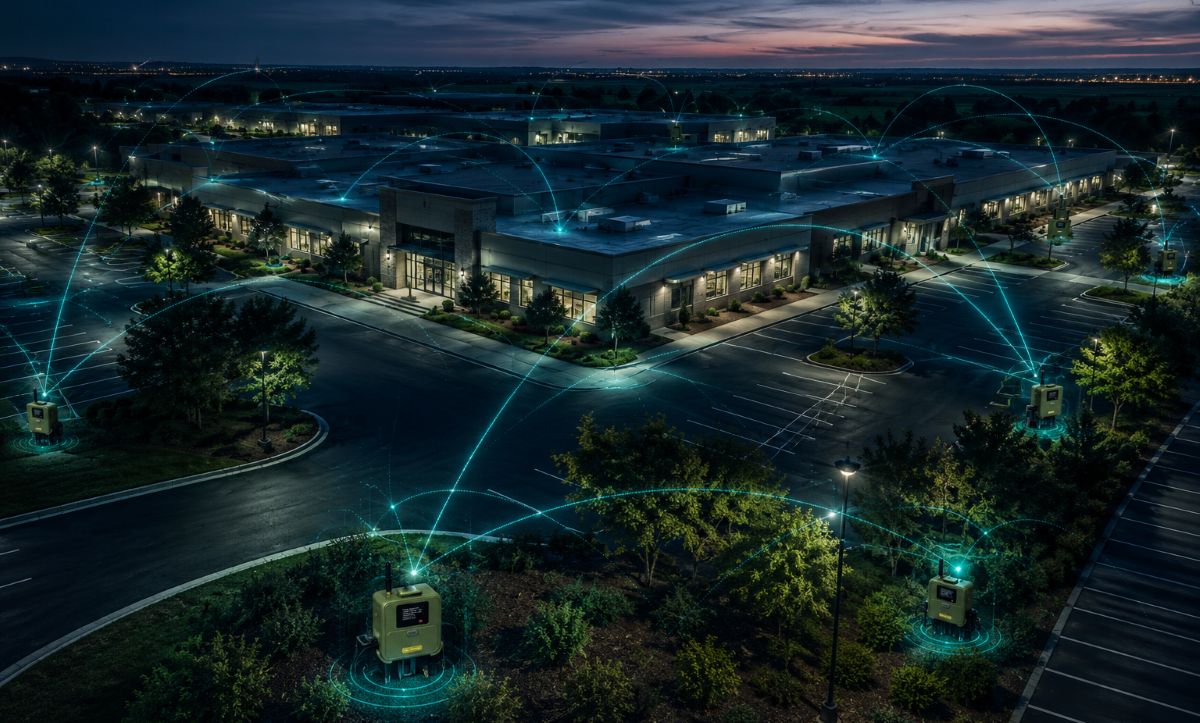
In a commercial property deployment, one device is configured as the Hub. The Hub connects to the property's WiFi network and serves as the gateway between the local sensor network and the cloud platform. The Hub also operates a LoRa radio, bridging communication between the cloud and all sensor nodes on the property.

Sensor nodes connect to the Hub over LoRa. Each Hub supports up to 32 nodes. Nodes don't require their own WiFi connection, they transmit sensor data over LoRa to the Hub, which relays it to the cloud. The only node that needs to be near WiFi infrastructure is the Hub itself.

For properties larger than a single Hub's coverage radius, multiple Hubs can be deployed, each connecting back to the cloud independently. The cloud platform aggregates data from all Hubs into a single property view.


What This Means for Installation

On a conventional wired sensor deployment, every sensor location requires a cable run back to a central controller, through conduit, through walls, across parking areas, under landscaping. Installation cost often exceeds hardware cost, and any future changes to sensor placement require physical reconfiguration of the cable infrastructure.

On a LoRa mesh deployment, the Hub goes where WiFi exists. Sensor nodes go where measurements need to happen, secured in their enclosures at the installation point. The only wire at each sensor node is the 24VAC power supply for the solenoid valve, standard irrigation infrastructure already present at most commercial properties. No communication cable. No conduit runs. No trenching for signal wire.

For a commercial property manager deploying monitoring across a multi-building portfolio, this compresses deployment timelines from weeks to days and eliminates a significant category of installation cost.


Resilience and Battery Backup

Commercial IoT deployments face real-world failure modes that lab specifications don't address: power outages, network interruptions, individual node failures.

Each sensor node in the Drip Defender and Water Buddi platforms includes an internal battery providing up to 24 hours of continued operation through power outages. During an outage, nodes continue measuring and storing readings locally. When power is restored, buffered data syncs to the cloud platform and the historical record remains complete.

The LoRa mesh self-heals around node failures. If an individual node goes offline, the Hub continues receiving data from all remaining nodes. Alerts fire when a node stops reporting, so the monitoring team knows immediately.


Frequently Asked Questions

Does LoRa work in urban environments with dense RF interference?

LoRa's sub-GHz frequencies experience less interference from the crowded 2.4 GHz and 5 GHz bands used by WiFi and Bluetooth. Urban deployments require attention to frequency coordination and transmission power settings, but commercial LoRa deployments in dense urban environments are well-documented and operationally mature.

What's the difference between LoRa and LoRaWAN?

LoRa is the physical radio modulation technique. LoRaWAN is a network protocol stack built on top of LoRa, typically used with public or private network servers. The Telemetry Insights architecture uses the LoRa radio layer in a proprietary mesh configuration managed by the TI cloud platform, providing range and power benefits without dependency on public LoRaWAN network infrastructure.

Can the same Hub support both foundation monitoring and irrigation control nodes?

Yes. The Hub manages communication for all node types on the property, soil moisture sensors, valve controllers, and environmental sensors, through a single LoRa mesh. The cloud platform routes data and commands to the appropriate device type based on node configuration.

What happens if the Hub loses WiFi connectivity?

The Hub buffers incoming node data locally during WiFi outages and syncs to the cloud when connectivity restores. Depending on outage duration and transmission frequency, several hours to days of sensor data can be buffered without data loss.


Learn more about Drip Defender → Related: How AI, ML, and IoT Are Rewriting Soil Moisture Management | Building Automation Meets IoT


LoRa Mesh Networking: Why Long-Range IoT Is the Right Architecture for Commercial Properties | Insights | Telemetry Insights | Telemetry Insights