Telemetry Insights
InsightsBuilding Automation Meets IoT: How Integrated Sensor Networks Protect Commercial Structures

Building Automation Meets IoT: How Integrated Sensor Networks Protect Commercial Structures

Stephen Harris · Founder & CEO, Telemetry InsightsMarch 2026
building automationIoTcommercial buildingssensor networksBuilding Buddi
Building Automation Meets IoT: How Integrated Sensor Networks Protect Commercial Structures

Published by Telemetry Insights | March 2026


The commercial building management landscape is bifurcating. On one side: traditional BMS installations built around proprietary protocols, expensive integration middleware, and centralized control systems that require specialized technicians to configure and maintain. On the other: modern IoT sensor networks built on open standards, commodity hardware, and cloud AI platforms that provide equivalent or superior functionality at a fraction of the cost and complexity.

The economics and capability arguments for cloud-native IoT now favor the modern approach clearly for most commercial building applications, particularly for the structural and environmental monitoring use cases that traditional BMS systems were never designed to address.


What Traditional Building Automation Misses

Traditional Building Management Systems were designed around HVAC control, lighting, and access management. They're good at what they were designed for. What they were not designed for is the full envelope of structural and environmental conditions that determine the long-term integrity and operating cost of the building.

Soil moisture at the foundation perimeter, not a BMS sensor. Differential moisture behavior between the north and south faces of the building, not a BMS data point. Subslab humidity trending upward in a way that predicts mold risk in 60 days, not a BMS alert. Soil temperature at depth approaching a threshold that historically precedes foundation movement, not a BMS parameter.

These are not edge cases. They are the conditions that drive the most expensive commercial building maintenance events. They're invisible to traditional BMS, and they remain invisible until they manifest as a structural event, a tenant complaint, or an insurance claim.


The IoT Sensor Layer

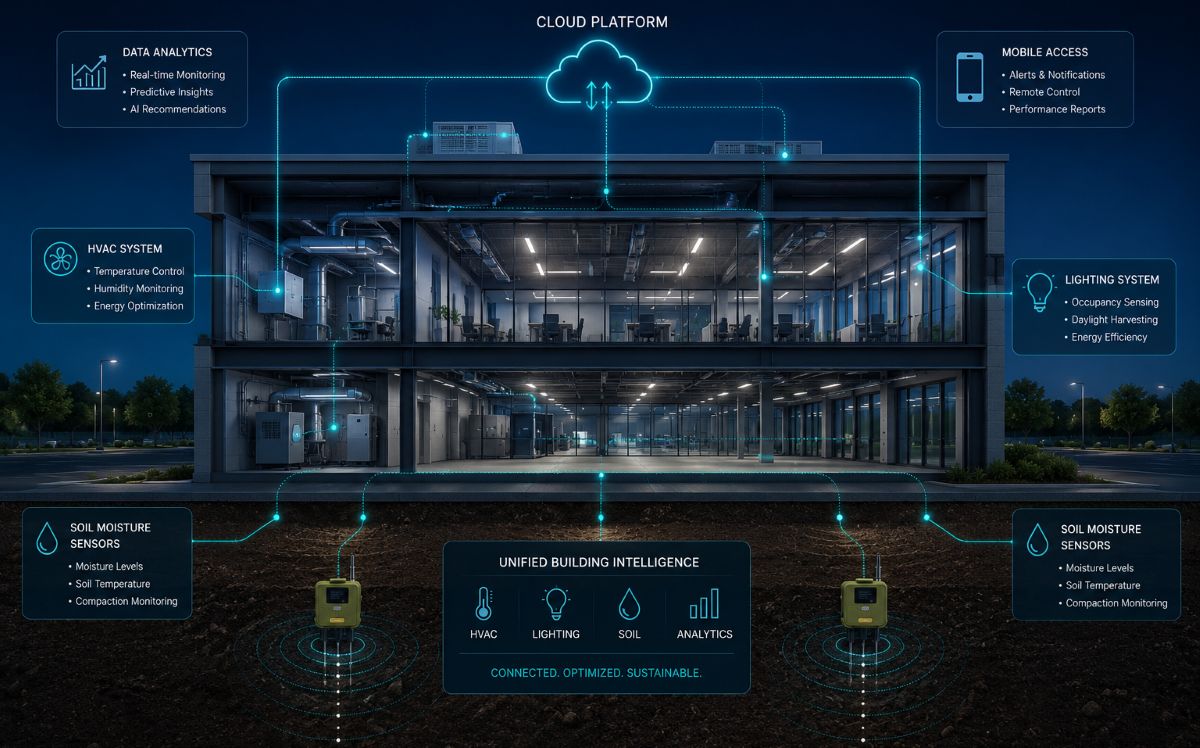
A modern commercial IoT sensor deployment adds a physical measurement layer to the building that captures what traditional BMS doesn't.

At the structural layer: soil moisture, soil temperature, and barometric pressure at the foundation perimeter. At the environmental layer: air temperature, humidity, CO₂, and VOC levels in occupied spaces. At the mechanical layer: vibration signatures from HVAC equipment, water flow rates through distribution lines, and electrical consumption by circuit.

Each data stream is continuous, timestamped, and ingested by the cloud AI platform where it contributes to a holistic model of building condition. Individual sensor readings are less important than the patterns they form over time, seasonal trends, anomalous deviations, correlations between parameters that predict developing conditions before they become events.

The hardware to deploy this layer has become commodity. ESP32-class microcontrollers with LoRa radios, paired with RS-485 Modbus sensors for soil conditions and standard Zigbee or Matter sensors for environmental monitoring, deliver professional-grade data streams at costs that make full-building coverage economically straightforward for most commercial property budgets.


Cloud AI as the Building's Intelligence Layer

The sensor network generates data. The cloud AI platform makes it actionable.

Anomaly detection algorithms identify deviations from the building's established seasonal and operational baselines. A soil moisture sensor reading 5% lower than its 18-month historical average for this time of year, trending downward faster than ET₀ modeling predicts, flags a potential drainage change worth investigating before it becomes a foundation risk. An HVAC vibration signature that has shifted subtly over 30 days flags a bearing wear condition weeks before it would be detectable by scheduled inspection.

Predictive maintenance, using historical failure patterns and current sensor trajectories to predict component or system failure before it occurs, is the highest-value output of the cloud AI layer. Instead of replacing components on a fixed schedule or after failure, maintenance is scheduled based on actual condition, reducing both premature replacement and unplanned failures simultaneously.

For structural monitoring, the AI maintains a continuous risk score for each sensor zone, updated in real time. Property managers see a dashboard showing current status across all parameters, with alerts surfacing only when the AI identifies conditions that require attention.


Integration With Existing Systems

A common concern about IoT overlay deployments is integration with existing building systems. The practical answer for most commercial properties is that IoT sensor networks are designed to be additive, not replacement systems.

Existing BMS installations continue managing what they were designed to manage. The IoT layer adds the sensor coverage and cloud AI that BMS doesn't provide. Data from both systems flows to a unified cloud dashboard, giving facilities managers a complete view without replacing existing infrastructure.

For new construction or major renovation, IoT-first architectures can deliver complete building monitoring at lower installed cost than traditional BMS for equivalent coverage, particularly when structural and environmental monitoring layers are included in the initial design.


Frequently Asked Questions

What's the difference between IoT building monitoring and a traditional BMS?

Traditional BMS systems are designed around HVAC, lighting, and access control using proprietary protocols and centralized hardware. IoT monitoring adds continuous structural and environmental sensor coverage, soil moisture, foundation perimeter conditions, equipment health, on open-standards hardware connected to a cloud AI platform. The two approaches are complementary; most commercial deployments layer IoT monitoring on top of existing BMS rather than replacing it.

What protocols do the sensors use?

The Telemetry Insights platform uses RS-485 Modbus for soil and environmental sensors, an industrial-standard protocol with broad hardware compatibility. Building interior monitoring supports Zigbee and Matter standard sensors, enabling integration with a wide ecosystem of commercial-grade environmental sensors without proprietary hardware lock-in.

Is there a minimum building size where IoT monitoring makes economic sense?

Any commercial building with a foundation value above approximately $200,000 has a positive ROI case for foundation perimeter monitoring based on avoidance of a single structural event. For most commercial buildings above 5,000 square feet, the math favors monitoring clearly.

How does the system handle the volume of data from a large commercial building?

Cloud-native architectures handle data volume through horizontal scaling. The platform stores raw time-series data for configurable retention periods, runs AI models continuously, and surfaces only actionable outputs to building managers. Storage and compute costs are a small fraction of the monitoring value delivered.


Contact us about Building Buddi → Related: LoRa Mesh Networking: Why Long-Range IoT Is the Right Architecture | From Reactive to Proactive: The Economics of Foundation Protection


Building Automation Meets IoT: How Integrated Sensor Networks Protect Commercial Structures | Insights | Telemetry Insights | Telemetry Insights