Published by Telemetry Insights | June 2026
The pitch has been the same for three decades: a fully integrated building, with sensors, cameras, HVAC, access control, lighting, and security all talking to each other, all visible from a single dashboard, all responding intelligently to conditions as they change.
The reality has been different. Achieving anything close to that vision required six-figure installation budgets, proprietary hardware locked to a single vendor's ecosystem, a certified integrator on retainer, and ongoing subscription fees to platforms that still required a specialist to interpret.
The result: genuine intelligent building automation has been the exclusive domain of major enterprise campuses and flagship government installations with dedicated facilities teams and seven-figure budgets. Schools, hospitals, municipal buildings, commercial warehouses, and mid-market commercial facilities have made do with disconnected systems, scheduled timers, and reactive maintenance.
That gap is larger than most people in commercial real estate or facilities management want to admit, and it's exactly the gap Telemetry Insights is building to close.
What It Does That Existing Systems Don't
The incumbents built their products around closed ecosystems and integration complexity, because that complexity justified their pricing and locked customers to their platforms.
Building Buddi is built around the opposite philosophy.
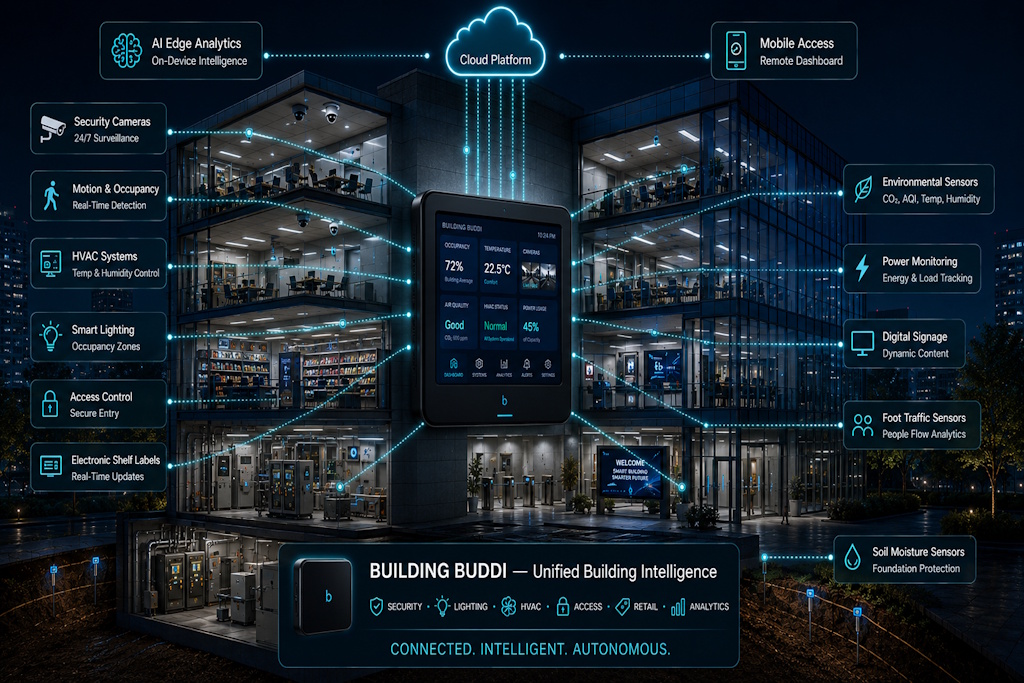
It sees the whole building. Security cameras, environmental sensors, access control, HVAC sensors, power monitoring, and occupancy data are all visible in a single dashboard on the device's touchscreen and on the building manager's remote dashboard from any browser. Not stitched together from separate vendor apps. Native.
It understands what it sees. On-device AI runs continuously against the full sensor history, not just point-in-time readings. Anomalies, occupancy patterns, environmental deviations, and equipment behavior changes are identified and alerted on before they become problems.
It communicates naturally. Building managers and tenants can interact with the hub using voice. Ask it a question about building conditions, request a status update, or issue a control command, all through a conversational AI interface running directly on the device. No app required, no ticket to submit, no specialist to call.
It connects to what's already there. Existing wired sensors, legacy HVAC controllers, access control systems, and commercial-grade equipment don't need to be ripped out. The wired sensor and control bus supports the full range of commercial building devices and protocols. Building Buddi integrates, it doesn't replace.
It drives retail operations. For retail environments, Building Buddi replaces multiple standalone systems with one. Camera monitoring, access control, and intrusion detection handle store security. Lighting automation responds to occupancy and zone activity, reducing energy costs without manual scheduling. Beyond facilities, the same sensor and camera intelligence tracks foot traffic flow, occupancy by zone, customer wait time at checkout, and dwell time at displays in real time, feeding staffing decisions, store layout optimization, and queue management. Integration with digital signage and electronic shelf labels means promotional content and pricing can respond dynamically to what's actually happening on the floor.
It works if the internet goes down. Edge AI and local control mean the building doesn't go dark if cloud connectivity is interrupted. Core automation functions run locally. Cloud connectivity adds remote access, historical analytics, and AI enhancement, but it isn't a dependency for basic operation.
Who It's For
Building Buddi is designed for the buildings that have been systematically underserved by the incumbent market.
Schools and educational campuses where student safety, environmental conditions, and access control across multiple buildings matter, but per-building automation budgets don't support enterprise systems at every facility.
Hospitals and healthcare facilities where environmental compliance, equipment monitoring, access control, and security are operational requirements, not optional enhancements, and where system downtime is not an acceptable outcome.
Government and municipal buildings where the combination of security requirements, budget accountability, and long operational lifecycles demands capable, cost-effective, auditable building management that doesn't lock a municipality into a proprietary vendor ecosystem indefinitely.
Commercial office buildings where facilities managers are stretched thin and reactive maintenance is the norm, because the tools for proactive monitoring have been priced out of reach.
Warehouses and industrial facilities where environmental monitoring, access control, and equipment oversight are operationally critical, but the workforce running these facilities doesn't include a dedicated building automation specialist.
Retail stores and multi-location chains where Building Buddi serves as the complete store intelligence platform, not just one system among many. Security camera monitoring, access control, and intrusion detection replace standalone alarm and surveillance systems. Lighting automation responds to occupancy, time of day, and zone activity, cutting energy costs without manual management. Foot traffic analytics, customer wait time management, digital signage, and electronic shelf label integration turn the same sensor network into a direct operational and revenue tool. Staffing decisions, checkout queue management, promotional display timing, and real-time dynamic pricing on digital shelf labels, all driven from a single hub that a store manager can actually operate without a specialist on call.
Managed property portfolios where a single operator oversees multiple buildings and needs unified visibility across all sites without paying enterprise integration fees at each location.