Telemetry Insights
InsightsSiri, Alexa, and Google Weren't Built for Your Building. Here's the Voice AI That Was

Siri, Alexa, and Google Weren't Built for Your Building. Here's the Voice AI That Was

Stephen Harris · Founder & CEO, Telemetry InsightsJuly 2026
conversational AIvoice assistantbuilding automationsmart buildingSiriAlexaGoogle Assistantedge AIcommercial real estatefacilities managementon-premise AITelemetry InsightsBuilding Buddi
Siri, Alexa, and Google Weren't Built for Your Building. Here's the Voice AI That Was

Published by Telemetry Insights | July 2026

Almost everyone has talked to a machine this week. You asked for a timer, the weather, a song, the traffic home. Siri, Alexa, and Google Assistant have made talking to a computer feel ordinary, and for the things they were built for, they work.

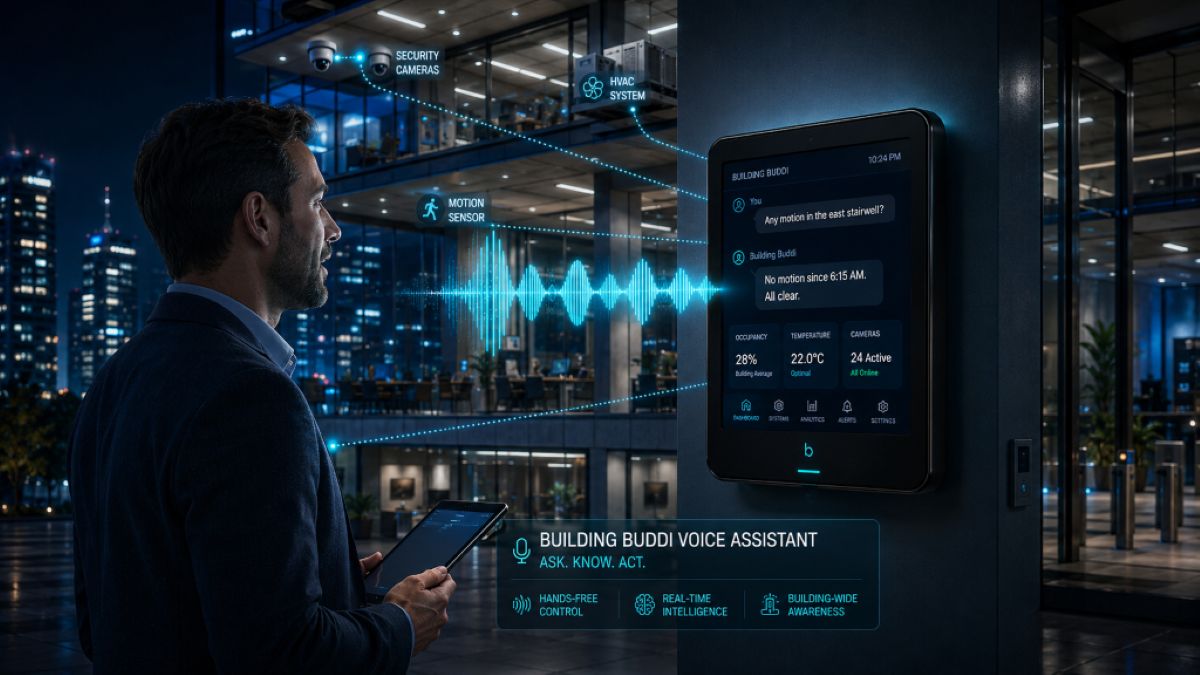
Now walk into a commercial building and ask one of them a question that actually matters to the people who run it. Was there motion in the east stairwell overnight? Which rooftop unit is throwing errors? Is the server room too warm right now? Every one of them goes blank. Not because the voice isn't good enough. Because it has no idea what building it's standing in.

That gap, between an assistant that can hold a conversation and an assistant that actually knows your building, is the entire reason we built the conversational AI inside Building Buddi the way we did.

The Problem Isn't the Voice. It's What's Behind It.

The consumer assistants share three traits that are perfect for the kitchen counter and disqualifying for a building.

They're general, not grounded. They answer from the open internet and a handful of account settings. They hold no live model of your cameras, your sensors, your HVAC, your access control, or what any of it is doing at this moment.

They live in someone else's cloud. Every request is tied to a personal Apple, Amazon, or Google account and processed on that vendor's servers under consumer terms. For a school, a hospital, a municipal building, or any operator responsible for physical security, sending building occupancy and camera activity into a consumer cloud tied to someone's personal account is a non-starter.

They take commands, they don't hold conversations. The interaction model is wake word, one command, done. Ask a follow-up and you start over: new wake word, no memory of what you were just discussing.

None of that is a defect. It is what a consumer assistant is. It is simply the wrong shape for a building.

Three Things a Consumer Assistant Structurally Can't Do

We have put Building Buddi's assistant side by side with all three. Three differences stand out, and they are the hard ones to copy, because each one depends on the building's live data being in the loop.

It hears you in a real room. Building Buddi uses modern, high-accuracy speech recognition, and the language model behind it repairs the domain terms a facility runs on. When someone says "air handler," it does not transcribe "error handler." A junk-wake guard refuses to respond to background noise, so it never answers an empty room. When the network is unavailable, on-device recognition keeps it working.

It knows the answer, because it can see the building. Every question is answered against the building's live state, assembled on the device at the moment you ask, including motion, occupancy, doors, environmental readings, equipment status, and the areas of your site. It answers questions nobody wrote a "skill" for, from what is actually happening right now, not from a script somebody had to anticipate in advance.

It stays in the conversation. Ask a question and it keeps listening, without making you say the wake word again, carrying both the thread of the conversation and the building's state forward. It feels like talking to someone who is in the building with you, rather than reissuing isolated orders to a machine. For a manager walking a floor with their hands full, that difference is the entire experience.

Here is the same comparison in one view.

Siri · Alexa · GoogleBuilding Buddi
Understands your building's live stateGeneric; no model of your systemsEvery camera, sensor, and system, every turn
Real back-and-forthOne command, then doneConversation carries context across turns
Speech recognitionOn-device consumer recognitionHigh-accuracy, with facility-term repair
Where your data livesVendor cloud, account-tiedOn your hardware, on your own AI account
Model, voice, and capabilitiesFixedCurated and selectable, per device
Works offlineLargely cloud-dependentWake word and recognition fall back locally

The Part That Matters After the Demo

A good demo is easy. What decides whether a building operator, a healthcare system, or a government tenant can actually deploy something is the part that never shows up on stage.

Your cloud, your account. Customers bring their own AI account. The spend is theirs and, more importantly, the data boundary is theirs. Building occupancy, camera activity, and the building's address never ride a consumer cloud tied to a personal login.

On the premises, and fleet-managed. The assistant runs on the same Building Buddi hardware that already sits in the building, provisioned and updated centrally so one operator can stand up hundreds of sites without hand-configuring any of them.

It works with no account at all. Building Buddi's assistant is fully functional out of the box, at no cost, so a prospect can use the real thing before paying anyone. Add your own account and the better voice, the stronger model, and the sharper recognition follow. An upgrade, never a prerequisite.

It keeps working when the internet doesn't. Wake word and speech recognition fall back to the device, so a network interruption does not leave a building unable to talk to its own systems.

"But They All Have AI Now"

It's a fair question. Google has folded generative AI into Gemini, Amazon has launched a generative Alexa, and Apple has Apple Intelligence. The models are getting genuinely good.

But the gap here was never the model. A consumer assistant, no matter how capable its language model, still has no live picture of your building, still processes your requests in an account-tied cloud, and is still built around a consumer's tasks rather than an operator's. Bolting a better model onto that architecture makes it a better consumer assistant. It does not make it a building assistant. That difference is structural, and it is not a feature any of them can simply ship.

The Same Engine Travels

Once you have built an assistant that grounds a real conversation in live context and keeps the data with the customer, the building stops being the only place it fits.

The pattern is the same everywhere a person is ready to talk and there is live information worth talking about: wake, converse, reason over what is actually happening, and keep the record where it belongs. Swap the building's sensors for another environment's live data and the same engine moves with it.

The clearest next environment is the vehicle. A driver is the ideal user for exactly the thing that works best here, a hands-free, contextual back-and-forth, and a modern car is full of live information worth asking about. It is a direction we are actively exploring, on the same foundation Building Buddi runs on today.

Where We Are

Building Buddi is in active development, and its conversational AI is one of the pieces furthest along. The architecture is defined, the hardware platform is validated, and the software stack is in build.

We are not announcing a launch date today. What we are announcing is a point of view about what a building's voice should be: grounded in the building's real state, owned by the customer, and able to hold an actual conversation.

If you manage commercial facilities, operate a property portfolio, or are responsible for building automation decisions, and if you have ever wished you could simply ask your building what was going on and get a real answer, we would like to talk to you. Early access conversations are open.

The Broader Picture

Building Buddi is one product in a growing Telemetry Insights portfolio. Water Buddi brings AI-powered precision soil moisture monitoring to agricultural operations. Drip Defender brings continuous foundation protection to residential and commercial structures using the same sensor and cloud AI approach.

Each addresses a version of the same problem: critical physical infrastructure going unmonitored or poorly monitored because the tools that could do it well have been too expensive, too complex, or too specialized for the operators who need them. A building that can hold a conversation about its own condition is the same idea, pointed at the moment a person actually asks.

That's the problem we are systematically working through, one product at a time.


Siri, Alexa, and Google Weren't Built for Your Building. Here's the Voice AI That Was | Insights | Telemetry Insights | Telemetry Insights